
The tomb of Paheri
Harvest scenes, banquets and boats painted with a miniaturist's care, 3,400 years old.
A hidden stop the larger boats sail past.
The big cruisers cannot stop here — no dock, no crowds, no ticket queue. Just painted tombs in a cliff above the east bank, and mud-brick city walls older than most of Europe's nations.

Harvest scenes, banquets and boats painted with a miniaturist's care, 3,400 years old.
A soldier's autobiography carved on his walls — the closest thing Egypt has to a war memoir.
Massive mud-brick walls of one of Egypt's oldest cities, silent in the desert.
El-Kab is the oldest thing on this stretch of river and the least visited. A mud-brick wall nearly twelve metres thick still encloses what was Nekheb, a settlement with roots in the predynastic period — before the first dynasty, before writing had settled into hieroglyphs, before Egypt was one country. The wall you see is later, but the place beneath it is older than almost anything else you will pass.
Nekheb was the cult centre of Nekhbet, the vulture goddess who was the protector of Upper Egypt — the white crown half of the double crown, paired with Wadjet of the Delta. Her name appears on royal titles for three thousand years. In the cliffs behind the town are rock-cut tombs of New Kingdom governors, and one of them, the tomb of Ahmose son of Ibana, carries an autobiography carved by a naval officer who fought in the wars that expelled the Hyksos. It is one of the earliest first-person war accounts that survives from anywhere.
We do not go ashore here. El-Kab sits on the east bank between Esna and Edfu, and the dahabiya passes it under sail in the early part of a day — the wall visible from the water, the desert rising behind it. A larger boat passes it at speed and at night. That is the difference, and it is the whole argument for this kind of sailing.
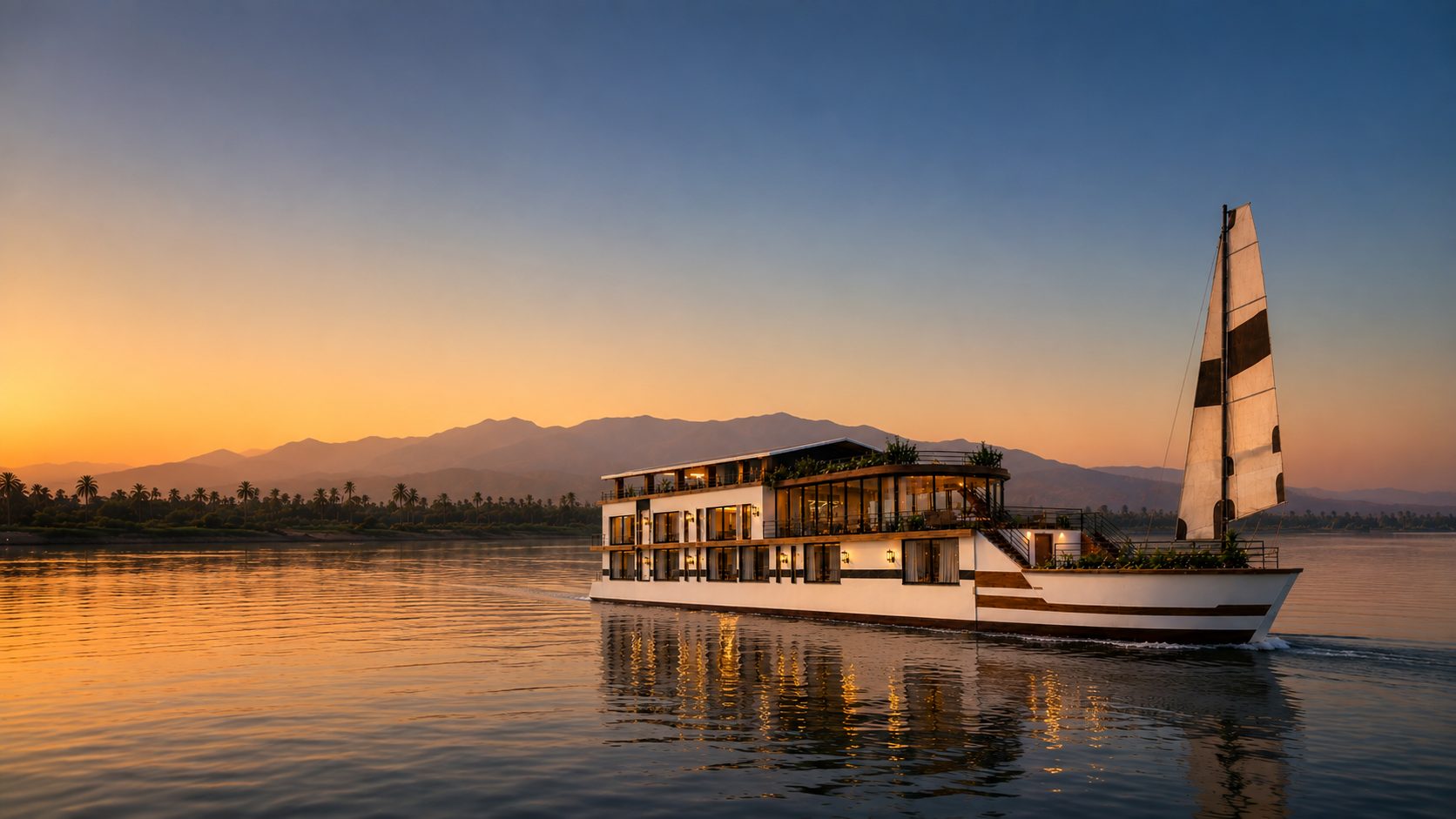
We anchor off the bank and take the launch ashore after breakfast — the site to ourselves, an hour before the sun climbs.